

By Ishpreet Khanuja
“Clean energy technology is no longer a niche story. It’s not climate romanticism.”
With those words, Dr. Timur Gül, Chief Energy Technology Officer, International Energy Agency (IEA), began retelling the story of a sector too often and too inaccurately still described through shifting cycles of climate ambition and hype. Presenting findings from Energy Technology Perspectives and the State of Energy Innovation 2026 reports, Dr. Gül invited innovators in the industry to look beyond the noise and see cleantech as a sizeable industrial market shaped by geopolitics, trade policy and questions of industrial competitiveness.
The opportunities within the sector are substantial, with mass-manufactured technologies such as solar photovoltaics, wind turbines, batteries, electric vehicles and heat pumps reaching a combined global market value of nearly US$1.2 trillion in 2025. The IEA expects that value to reach around US$2 trillion by 2035 under current policies. When governments’ stated policy intentions are included, this number approaches US$3 trillion. Yet if the market’s size marks a change in how we speak of opportunities in the sector, the foundations it rests on make that conversation far more complex.
For cleantech players seeking a place within this growth, understanding where demand is heading is only the beginning. Where is demand sufficiently mature to support a business today? What gives a Canadian company a credible reason to compete? What evidence will persuade a customer to take a risk on something new?
Following Gül’s presentation, we also heard from Dan Blondal, founder and CEO of Canadian battery materials company Nano One. Offering an on-the-ground example of Canada’s search for a place in this evolving global landscape, the discussion involved insightful lessons in where to innovate and knowing when to collaborate.
Where to Build When Growth Has Many Timelines
The IEA launched its Energy Technology Perspectives series in 2006, back when clean energy technology was largely discussed through the lens of climate research, development and deployment. Twenty years later, innovations in the field are informing key decisions around trade and policy.
“It’s important to recognize that there is, of course, more than just those technologies that underpin the age of electricity,” notes Gül.
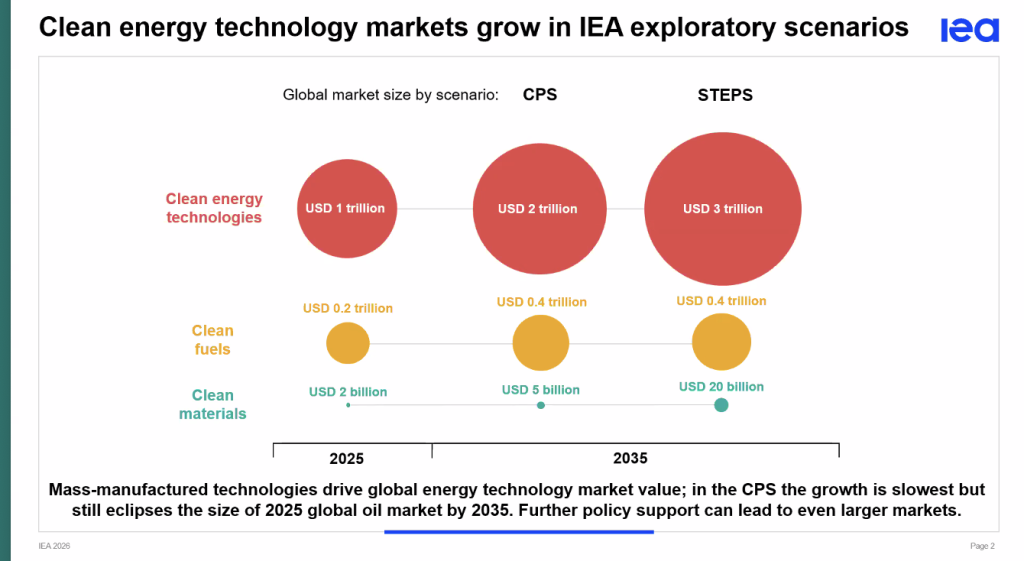
That wider market, however, is not advancing along a single commercial timeline. Low-emissions fuels, including established biofuels and emerging hydrogen-based fuels, represented a market of approximately US$215 billion in 2025, while low-emissions hydrogen continues to grow even as the excitement of its earlier hype cycle subsides. Investment in low-emissions hydrogen rose by approximately 80 per cent in the previous year, Gül noted, with committed projects suggesting significant growth through 2030.
These variations influence far more than market entry. An established technology may offer a larger addressable market, but with intense competition and pressure on margins. While near-zero-emissions materials carry the possibility of transforming enormous incumbent industries, many ventures in this area still need policy to help create a market willing to pay a premium.
For a founder, the useful question is therefore if the part of the market the company intends to serve is ready to buy, and whether that readiness matches the capital and time required to reach it.
Supply-Chain Gaps Reveal Opportunities
Alongside these differing commercial timelines, investment in clean-energy manufacturing exceeded US$200 billion at its 2023 peak, contributing to a manufacturing buildout that has left solar PV and battery capacity above current demand. While that abundance may appear reassuring, it says little about where capacity is located or whether factories elsewhere can obtain the inputs required to operate.
China produces around 80 per cent of the world’s solar PV modules and battery cells, with its position becoming even stronger in certain supply-chain segments. Translating the percentages into company scale, Gül shared how Jinko Solar alone could supply annual solar-module demand in either China or Europe, while Envision Energy’s annual wind-nacelle capacity is close to three times demand across the Americas. CATL could theoretically supply battery-cell demand across the world outside China.
Conducting an N-1 analysis, the IEA removed the largest supplier from each stage and asked how much demand the remaining producers could satisfy. In batteries and electric vehicles, enough cell manufacturing and vehicle assembly capacity exists outside China, at least in theory, to serve demand beyond the Chinese market. The constraint appears further upstream and through the middle of the chain, across critical-mineral refining, graphite, and cathode production. Without China, less than one-quarter of cathode demand could be met. Solar manufacturing encounters the same vulnerability at the wafer stage, while heat pumps rely heavily on access to rotary compressors.
“One container ship carrying solar PV panels brings you as much electricity over the lifetime of these solar PV panels as 50 LNG tankers or 100 ships carrying coal,” explains Gül.
If trade in solar panels were interrupted, the panels already installed would continue generating electricity. The disruption would instead appear in postponed projects, idle facilities, lost industrial output, and jobs that could no longer be supported.
In batteries, the IEA estimated that a one-month interruption in Chinese supply chain exports could reduce electric-vehicle production elsewhere by approximately US$17 billion, with import-dependent Europe facing the greatest impact. That figure also offers a measure of what supply assurance is worth. A company able to relieve one of the constrained stages is addressing a risk that can be expressed in delayed production and lost revenue, giving prospective customers a commercial reason to consider an alternative source.
For cleantech companies, this analysis offers a unique way to map opportunities beyond the large facilities, attracting investment. Those facilities depend on less visible materials and components that are often controlled by a small number of suppliers. As governments and manufacturers look for a second source of supply, companies working in these parts of the chain may find customers whose interest is driven by operational necessity.
The opportunity is especially relevant to Canadian ventures with capabilities in critical minerals, advanced materials, processing and industrial technology, where a focused solution can strengthen a much larger market without requiring the company or the country to reproduce an entire supply chain.
How China Built Its Advantage
The report examined production costs across hundreds of facilities to understand why alternative suppliers have struggled to emerge and found a Chinese advantage of approximately 30 to 65 per cent over Europe, with broadly similar gaps in North America. The sources of that advantage also changed with the product.
Low-cost electricity matters most in solar PV because polysilicon and wafer production consume substantial amounts of energy, while labour costs carry greater weight in wind manufacturing, particularly for blades and complex components such as gearboxes and generators. In batteries, automation and manufacturing efficiency play a key role. Chinese plants can achieve average yields above 90 per cent, meaning fewer than one in 10 batteries fail quality testing, while failure rates at European facilities can be two to three times higher.
For a country or company trying to compete in solar, the cost problem is therefore fundamentally different from the one facing a new entrant in wind or batteries. The variation highlights how policies and partnerships built around a general ambition to manufacture clean technology can easily miss the factor that determines competitiveness within a specific segment.
China’s advantages have also compounded through scale, supplier proximity, accumulated experience and sustained demand. The country installed more solar PV than any other market while exporting heavily at the same time. Approximately 40 per cent of the growth in Chinese solar-module production over the past decade went abroad, with Europe representing a significant destination. The IEA expects international markets to soon account for 40 to 50 per cent of production growth in Chinese batteries, electric vehicles and heat pumps.
“But an area that is sometimes a bit overlooked is that there is a flip side to the same story,” shared Gül. “Because conversely, the role of other countries and their markets in shaping China’s cleantech industry is also very important.”
While other countries have become reliant on Chinese production, their demand has also supported its growth, with recent declines in the profitability of China’s solar industry highlighting what happens when production capacity moves ahead of domestic and international demand.
Canadian Opportunity Depends on Choosing Where to Specialize
The desire to create those alternative suppliers has pushed localization onto policy agendas around the world. Gül recounts how every country he visited while presenting the report was trying to prioritize domestic production, even though very few possess the resources, market size and industrial base required to bring every stage of a supply chain within their borders.
Gül suggested beginning by exploring supply chain vulnerabilities, taking stock of current capacities, and identifying where a trusted international partner might be better positioned to contribute. Gül explained how Europe’s electricity costs, for example, weaken its position in energy-intensive solar components, creating a case for partnerships with lower-cost producers in the Middle East or North Africa. He also noted India and Brazil’s established industrial experience and competitive labour costs in wind manufacturing.
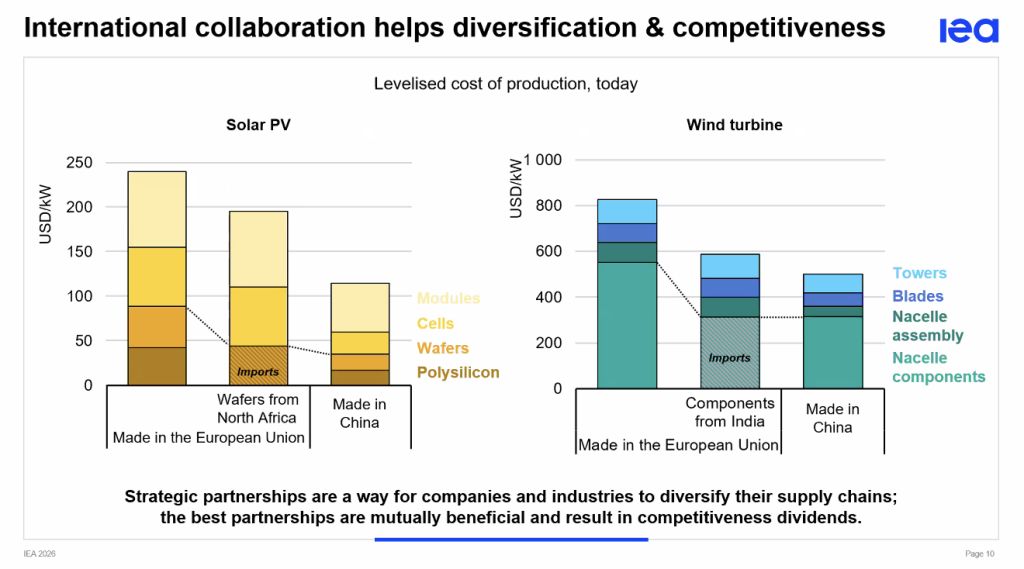
For companies, the same approach can distinguish partnerships that offer surface-level credibility from those that provide expertise, infrastructure, or market access capable of materially changing the path to commercialization.
Noting Canada’s advantages with critical minerals, advanced research and a reputation as a trusted partner, Gül sees an opportunity for Canada to build industries around those assets, but it will require choices. Domestic demand must be strong enough to support early production, policy has to remain in place long enough for operating experience to accumulate and companies need international partners capable of carrying Canadian technology into larger markets. The opportunity lies in owning consequential capabilities within an interdependent system, rather than attempting to contain the entire system within Canada’s borders.
Building at the Bottleneck: A Nano One Story
Valued for its safety, durability and lower cost, lithium iron phosphate (LFP) has become the dominant battery chemistry in China and an increasingly important option for mass-market electric vehicles, stationary storage, data centres and AI infrastructure, where batteries help manage variations in power use.
LFP was invented in the United States, while researchers in Quebec and at Université de Montréal developed a carbon coating that helped make the material commercially viable. Phostech Lithium began commercial production in Quebec in the early 2000s, at a Candiac facility that eventually became part of Nano One.
Over time, the processing technology and manufacturing expertise moved toward China, which now controls approximately 98 per cent of global capacity for iron phosphate, the precursor used to produce LFP cathode material. Final cathode production can take place across several countries, yet access to that low-cost precursor remains the tighter constraint.
Nano One’s One-Pot process integrates precursor and cathode production, avoids a sulphate intermediate and eliminates the associated wastewater stream. The process seeks to reduce reliance on Chinese iron-sulphate inputs while making facilities easier to permit and modularize.
By concentrating on an intermediate stage where China holds overwhelming control and where Canadian process knowledge and industrial partnerships could support an alternative, Nano One brings Gül’s argument for beginning with one consequential dependency into the real world.
Hard-Tech Scale Is Earned Through a Chain of Proof
Addressing a strategically important bottleneck gives Nano One a clear reason to exist in the market, but commercialization still depends on converting that relevance into evidence a customer can trust. Although the company has secured dozens of patents with many more applications in progress, Blondal placed equal emphasis on capabilities that cannot be captured fully in a filing.
“The learning curve is the one thing you cannot shortcut,” he said. The people behind the process, with their operating knowledge, trade secrets, quality systems and lessons accumulated through mistakes, determine whether it can meet industrial expectations.
Where a lab can prove technical possibility, full-scale equipment must demonstrate that the process can deliver repeatable quality through an economically credible flow sheet. With support from Natural Resources Canada and Investissement Québec, Nano One is re-automating equipment at its Candiac facility to establish that next layer of proof.
The facility may initially serve smaller customers, including defence buyers with a compelling reason to reduce dependence on foreign supply, but it cannot produce the volumes required by major automotive and stationary-storage customers. Reaching those markets would require a plant roughly 20 times larger, along with a bigger site, permits and close to half a billion dollars in capital.
That capital, in turn, depends on demand willing to commit. Battery manufacturers already face a difficult production ramp, where low yields can quickly undermine the economics of a new factory, and introducing an unproven material supplier adds risk at a particularly vulnerable stage. Established Asian suppliers arrive with the volume, quality and operating history manufacturers need, even when those same manufacturers recognize the strategic value of diversification.
Nano One is sequencing its growth around that reluctance, using smaller offtakers to validate its material, process, equipment and team. That operating record can support commitments from larger customers and eventually produce the bankable offtake required to attract lenders and equity investors.
Its partnerships extend the same logic, with Rio Tinto, Sumitomo Metal Mining and Worley bringing experience in materials, engineering and large industrial projects. This allows Nano One to contribute its process through a licensing model while working with organizations that have the capital and operating capacity to deploy facilities across multiple markets.
The progression reflects a broader reality for hard-tech companies, where scale is less a single leap than a chain of proof, and each milestone must resolve the concern preventing the next customer, partner or investor from committing. An initial market can be far smaller than the eventual ambition and still be strategically essential if it makes the next stage believable.
A Strategic Place in an Interdependent World
Quoting IEA Executive Director Dr. Fatih Birol, Gül described technology development as a marathon. Leading the early stages of innovation does not guarantee manufacturing leadership later, particularly when innovation still needs to work with industrial policy, manufacturing experience and demand.
After a technology becomes commercially successful, innovation changes its focus. Solar patenting accelerated as commercially promising products emerged, then declined once crystalline silicon became the dominant design. Activity is now growing around technologies such as perovskites. These patterns make patent data a useful signal for cleantech companies of how an industry is evolving and where the basis for future competition may be shifting.
Canada cannot build every clean-energy supply chain on its own, nor would trying to do so make for a good strategy. Like Nano One, a more informed ambition would be to understand where we are vulnerable, where our companies can build something dependable enough to change that calculation, and which partners can help carry those capabilities into the world. In an industry defined by interdependence, building one essential part exceptionally well may be how Canada earns its place in the whole.
For clean-tech founders, Altitude has developed a FREE resource kit that includes:
- Directory for climate-focused investors, non dilutive funding sources and growth opportunities to help bring your solution to market
- 10 free tools to measure, verify and communicate your environmental impact.

