
By Hessie Jones
On June 16, 2026, Altitude Accelerator convened an executive roundtable, across government, logistics and retail distribution, rail and transit hubs, investment partners and innovators to address the economic volatility, and the technological shifts that have challenged current systems.
The Western Greater Toronto Area (WGTA) corridor encompasses Halton and Peel Region. It is a vital transport to moving goods and serves a primary multi-modal hub that connects aviation, rail, and highways with access points to the U.S., western Ontario and connections to northern Ontario and Quebec.
The WGTA contributes 21% of Ontario’s goods-movement GDP and, on a weekly basis, 500k trucks travel through Peel Region carrying $10.8B in commodities. The cross-border influence is significant—18% of the goods that move between Ontario and the U.S. also originates in Peel.
The participant breakout sessions consistently identified these structural challenges facing Ontario’s supply chain:
- Traffic & infrastructure gridlock
- SME AI adoption due to capital/risk constraints
- Rising labour and resource costs
The dialogue centered on the following core themes (below chart). These areas are interconnected, and the roundtable discussions revealed the current challenges that not only define the current state but also what needs to be done to ensure a sustained and resilient logistics sector in Ontario.
|
Theme
|
Strategic Focus
|
|---|---|
|
Artificial Intelligence |
Deploying AI for administrative efficiency, predictive procurement, and route optimization while managing regulatory gaps and environmental footprint. |
|
Traffic and Mobility |
Mitigating congestion and aging infrastructure through optimized scheduling, HOV/dedicated lane access, and multi-modal resource sharing (e.g., off-peak rail). |
|
Labour and Workforce |
Addressing acute driver and operations shortages, rising insurance overhead, and workforce upskilling alongside AI adoption. |
|
Infrastructure |
Modernizing physical networks, developing multi-level logistics facilities, and better utilizing existing regional assets. |
|
Technology and Innovation |
Streamlining procurement and/or pilots, standardizing integration protocols, and enhancing cyber resilience across full-scale deployments. |
Core Theme 1: Artificial Intelligence
This technology is central to not only transformation but also can streamline workflows and reduce operational risks in the face of regulatory and governance frameworks that have yet to keep pace with adoption.
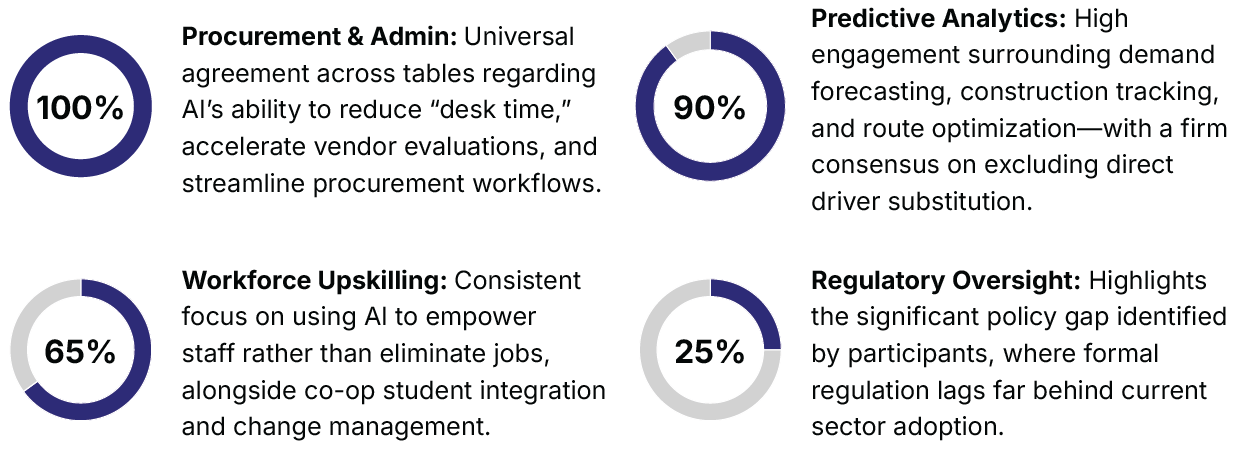
The report highlights key AI applications that will yield significant business value—among them, expediting procurement processes to get to pilots faster, leveraging predictive analytics to lend greater accuracy and routing and operational visibility, and ensuring mandatory risk analysis and cybersecurity vulnerabilities and calling for provincial guidelines and standards.
Operational efficiency through process automation is in demand; however, the administrative friction, process effort, and workflow re-engineering takes time. AI decision-making requires proper data management, including “parsing operational data” to help ease procurement processes.
The report highlights the importance of predictive analytics to gain better operational visibility in areas like construction monitoring, inventory management, and demand planning.
Participants emphasized the importance of applying “AI analytics to everything but the driver,” noting the need for human drivers to remain cost competitive as the “regulatory frameworks mature.”
A significant pattern within the AI discussions was the preservation of human capital with the goal of AI augmentation rather than displacement.
One participant, Dirk Schlimm, Distinguished Executive in Residence, GEOTAB emphasized,
“To move forward and embrace the future, we need to maximize the potential of artificial intelligence while preserving the essential human component required to build and effectively manage relationships.”
To unlock full insights from the report across key themes …
- Artificial Intelligence
- Traffic and Mobility
- Labour and Workforce
- Infrastructure
- Technology and Innovation
We thank everyone who contributed their time and insight.
Thank you to our sponsors, InsurePlus and the City of Brampton for helping make the roundtable possible.
Altitude Accelerator supports founders developing solutions within the logistics sector. We also provide AI resources to guide founders as they integrate agentic capabilities into their solutions. Go to our AI Resources page to discover curated articles, and webinars from AI-powered coding and prototyping to data privacy to developing agentic applications.
We are always looking to support promising companies for growth and scale. Please peruse our program page to learn more about Market Readiness and Investor Readiness.

