
Listen on Spotify
Watch on Youtube
Transcript
Hessie Jones
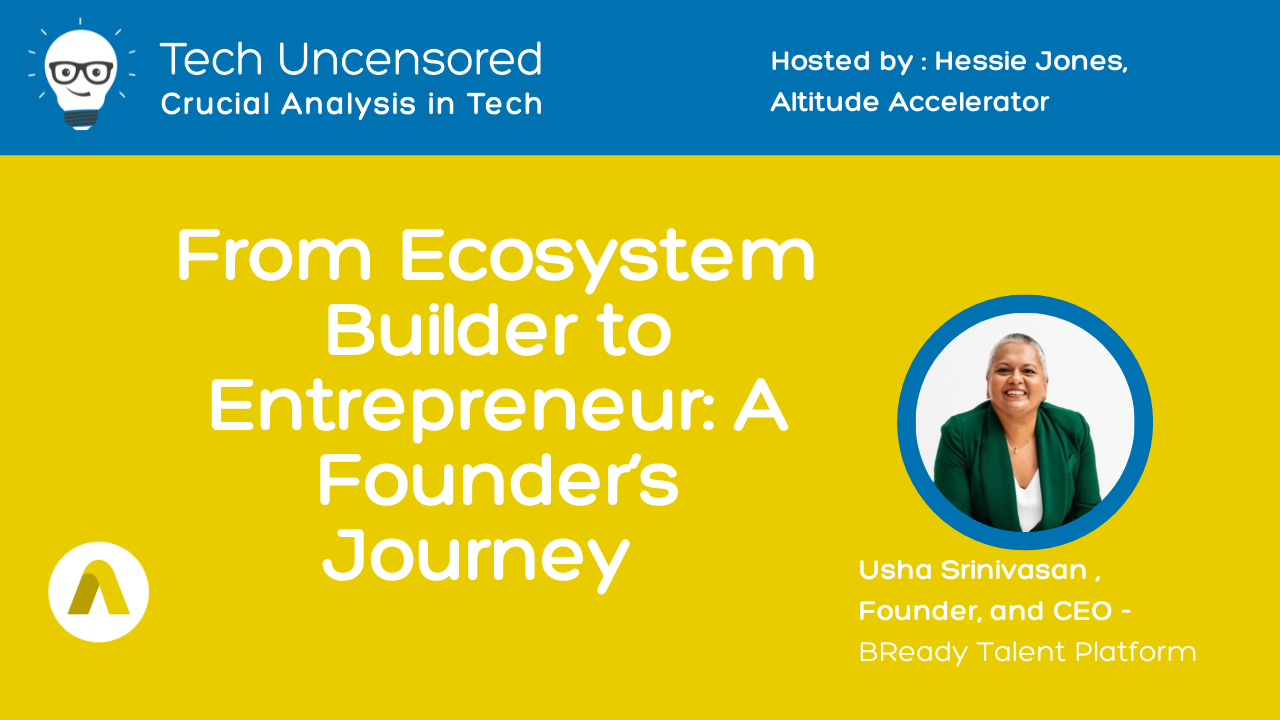
So today we are focusing on one person, someone who’s worked on both sides of the aisle, from supporting entrepreneurs. To now deciding to take a leap fully into developing her own startup, we show us from the basin is an ecosystem builder, and she’s worked in economic development for 15 years. Supporting startup entrepreneurs and program development through Mars through Elevate and most recently, Frampton Venture Zone, welcome to Tech Uncensored everyone. My name is Jesse Jones and today we’re going to talk about we’re going to talk to. Friend of us and she’s always been a builder and she has leveraged her network to try to pass for many founders and develop very. Pertinent programs to bring these founders to the next level along the way, in her own words, she has run side hustle projects, passion projects from her own consulting business to managing a small reggae record label. I want to. Hear more about. That to running a bakery business in. Toronto in in the beaches, in town. No. So now Usha has decided to become a full-fledged startup founder for a teller platform called Be Ready to support in one of her as one of her passions, underutilization of immigrant and Bipap talent in Ontario, and specifically trying to connect them to small. Enterprises as well as startups, so this conversation is about ushi’s path from economic development to entrepreneurship. So welcome Usha.
Usha Srinivasan
Hi there Hessie.
Hessie Jones
So but I want. I want the audience to to know a little bit about your journey and when you even just started working on the corporate side, did you ever envision, do you think at that time that you’d ever be? In this seat.
Usha Srinivasan
Ohh far from it, far from it. So I have a science background. I started my career as a uh academic as a I’m a clean **** scientist by training, so for sure did not expect myself to be in the entrepreneur seat for sure or not.
Hessie Jones
- So tell me. So you you said you were scientist, so. Clean tech. What was it? What did you want? What did you aspire to be? When? When you came out of.
Usha Srinivasan
To be honest, I think my parents wanted me to be a doctor and I did not want to pursue pursue that. My father was a pediatrician, so eventually research was something, you know, the the second best was being a PhD doctor rather than a physician. Dr. So that’s what I. It came, but I I love research. I think all the researchers have that sense of curiosity and discovery. And so being in the lab and working on more actionable science lists, you know something I really enjoyed and I thought I would be a professor eventually. Really. Teaching at a university which I still love teaching, so that would have been my path if I had not pivoted.
Hessie Jones
So what? So when did you make the transition to Mars? Like, how did that happen?
Usha Srinivasan
Yeah. So I went from academic research to market research, so I went to a company called Frost. Sullivan, for about 8 years where I led their building and and marble technologies practice for North America and how I ended up at Mars is quite by accident. I was working for a U.S. company. Traveling a lot to the US and working with large companies like GE and you know IBM etc. But I realized my own market in Ontario was kind of underserved because we used to have a. Lot of startups. Come to Frost and Sullivan looking for market research and most of the time. They couldn’t afford the consulting or even the reports that we wrote. So I I realized it’s like untapped market like unreserved market in, in the startup community and that’s how I ended up at Mars. So I and cannot approach them and say, hey, I see you. Work for you work with startups. Uh, literally saying, is there a role for me? Most of my roles I’ve kind of found them myself. I haven’t applied for a job to date, which is which is a blessing, I guess. And so they said, yeah, we’re we’re trying to establish a market intelligence division for startups and that’s how. I ended up at Mars.
Hessie Jones
Ah, so you were the you’re the brains behind what is now, I guess Mars, the Mars intelligence, the insights. That’s correct. Amazing. And that and, you know, for many founders who who don’t know about this, it’s it’s fantastic. I think the value is like 20,000 plus for the reports and then you. That you get access to research when it comes to capital insights as well as market. So you can do your Tam Samsung and even lead generation. So it’s become incredibly valuable to to many founders. So thank you for for doing that. So so in your time. At Mars, like besides establishing the the research side, what what were the other things that you? Envisioned for your role and what you wanted to provide as value.
Usha Srinivasan
To be honest, I was extremely lucky to have gone gone into Mars at that early stage. I was employee number 25 back in 2008 and and Mars was itself a startup. You know, we we were still figuring things. Out and a lot. Of we had some some funding, we had this building, we had a vision, an amazing committed leaders that I had the the lucky fortune of working with from the CEO, Elsa Karnik to many others that I I was reporting into over those 10 year period and. So it was really a, you know, an environment where you you put your hand up when there’s new ideas, there is no no dearth of great ideas from different people to say what else should we be doing to support the entrepreneur community so. I I am so grateful for all the amazing things we ended up doing, whether it was the market intelligence services that eventually grew to across Canada or and the entrepreneurship programming which used to happen as an in person programming, which then grew to an online audience. From there we managed. And you know, of course, funding to all the regional innovation centers that many people didn’t know that. It’s happened from. Ours, including to altitude accelerator and that’s how I know Pam for for many years. But you know, for myself, I just, you know, learned so much. It was like drinking from the hot fire hose a lot of times because I was going outside of my comfort zone of market research to entrepreneurship, education and working with startups and managing. Ramps and and I I think at some point I had almost close to 100 people in my team because there were in different divisions across venture programs and talent and and so. That, you know, working in that environment, you exposing yourself to startups every day, day in and day out, that’s when you start thinking, hey, maybe should I should I get into entrepreneurship myself, you know, is there something I should try? And and in my case? You know, lack of a better word. I’m going to say I felt like an imposter still, because here I was developing programs for startups, but I had no idea what it meant to be a founder of a startup. And so that was always, in my mind, I think, you know, that was what transitioned me to stop working at Mars and then be a a founder myself. When I left there.
Hessie Jones
OK, so when when you left Mars, you went to elevate, is that right or how long before you went to elevate? What? What happened?
Usha Srinivasan
It was actually an interesting arrangement I had with Elevate CEO, then elevate CEO Razor Solomon. And he knew that I was leaving to build a stop. I had a another business called House Chef. I my my co-founder, was a a chef, and we had a home social dining company where, you know, people, foodies who like. Exploring different kind types of cuisine would come into a chefs home. It could be a very well known chef or. A home cook. But they were regardless, coming into somebody’s home to experience having home social, dining experience, that was the business I was going to build. And with the elevate I I had this arrangement that I would would work 6-6 months of the year so that I could actually build my business the rest of the time. So that was so calculated risk. I’m sure you know. Your audience is a mix of entrepreneurs and others. How they calculated risk because I was going from a full time job, still had a family to support, to go into a part time ish and then still pursuing my desire of building a new business.
Hessie Jones
Yeah. How old were your kids at that time and how many kids did you have? At the time that you said.
Usha Srinivasan
I have I have that that was I have two. I have two kids and they were in high school at that time. They were guys.
Hessie Jones
And. So they didn’t need mom full time, but at the same time. Yeah. Yeah. Did you find it? Did you find? How how much of your life change significantly when you made that choice from from Mars?
Usha Srinivasan
Yeah, you know, this is something, you know, entrepreneurs should know. You, you know, entrepreneurship. Building a business is not easy like you have, especially at the age, you know, it has a different age range. Different things are important. Right when you’re young and you’re building a business. Maybe you don’t have that many responsibilities. And yes, you could live in a very you could live in the moms basement, not pay rent and be OK not have any savings, you know, eat, eat, eat simple food, etcetera. As you get older. Although you might have savings or, you know, be able to financially be able to afford that you have. Still have higher responsibilities if especially if you have a family and children, so you know it’s really comfort level of what you want and you don’t have life experiences as a young person. So what are you going to build and then when you have an older state? You have tons of experience from livid experience, plus work experience that you can leverage. So I feel like there’s a little bit of A and there’s advantages and disadvantages at different times of your life, right to when you’re building the the business. But the life does change a lot. You know, here, you you no no longer have a nine. 5 so I told chose two really crazy businesses, food tech as an entrepreneur and events. Events of, you know, running and, you know, being at Elevate, 20,000 people showing up in event. It is a crazy amount of pace for for event business. So yeah, there’s very little.
Hessie Jones
You know, were those things, two things happening concurrently or were they like 6 months doing this and then six months off is that?
Usha Srinivasan
Happening concurrently, they’re OK.
Hessie Jones
Oh my goodness.
Usha Srinivasan
Yeah, but you know there at elevate, I was wearing multiple hats. So thanks to Raiser I was had a partnerships managing some recruitment, managing startup open House. So the three months leading up to elevate is very intense. And then the rest of the time, you know, you’re keep doing that because you know, elevate as you know it goes from, you know, 10 people to 300 people in a short period of time with with the both full time employees and all the the volunteers. So it was quite something to watch. Some of the amazing colleagues that I worked with, you know. But I had never worked in an events business of that sort of that magnitude. So that’s quite something to watch them take that on.
You know absolutely and obviously it was an an amazing networking opportunity as well for you to to be at the forefront. Of building something, especially with the Canadian Canadian market, we didn’t really have anything of that size. Great. Yeah. Razor started to elevate when there we didn’t have collision. We didn’t have. We had Discovery X, but it was still very much research and university focused Discovery acts. And let’s start up focused before, I mean early days, but elevator really came and filled that gap, right.
Hessie Jones
Yeah. So how long were you there for and when, like, what happened after that? Because at some point you started thinking about? Building your own.
Usha Srinivasan
That that’s. That’s right. Well, back conventions on SO2020, if you remember what happened in 2020. COVID.
Hessie Jones
Don’t know.
Usha Srinivasan
So call it happened to me as well, and I always think my God, I mean, it’s either bad luck or it’s just meant to be that I chose even. That’s and A food, food, business, food, tech, business. Like no one’s going to go for any home social dining anytime soon because, you know, people were scared out of their mind getting sick from this bug that they didn’t know what was going on with it. And events. I mean, it was extremely difficult. Time for raiser because we. You know, Razor is an amazing salesperson. He worked, you know, 8 months in advance, nine months in advance and securing partners and people were just unsure of what was going to happen to the world. Right. So he had to make it the the difficult decision of, you know, letting people go. And as the chief of Staff, I mean, I I can no longer be there. As a result, either so the organization shrunk to, you know, a few people very quickly. And so I was out of a job, to be honest with you. I was out of a job at that time and and but I had to really think hard. So any entrepreneur thinking of building anything, anything can happen. At any time, right you could. You could be in a market that is completely not possible and then look at the the, the, the current tariffs and how many startups might be affected by that, right. So so anything can happen in the world at any time. As an entrepreneur, as a woman entrepreneur, one of the things I learned the hard way because I think we’re going to be talking about good things and bad things is make sure you have a diversified revenue source for you as a person. Extremely important if anyone is thinking about building a a startup and when I mean.
By that, you know, maybe have a rental income or have other investments or other side households where that brings in money a passive incomes. You whatever needs to happen you you need to make sure you do that. Not everything can be in one bask. And that is a dangerous thing for anyone to do, especially if you are thinking about an entrepreneur, A pathway. So I learned that the hard way to be honest with you. And it woke me up to saying, you know what? We need to smarten up about. If you ever do this again, you’d be smart, smart about it. But also looking for the. How I ended up at T MU was I saw this ad for a new incubator and you know, I had always wanted to, you know, after the experience that had at Mars, I thought wouldn’t be. So much fun to build a brand new incubator, especially in the community that I can relate to because I’m South Asian myself and came to Canada in 97 and I thought, wouldn’t that be amazing if I had the opportunity to build a brand new incubator and at that time altitude was not there in Mississauga, you know, you came. I think later I think you were still sorry you were not in Brampton, I should say you were in Mississauga still and you know, having the opportunity to build it a a new incubator focused on technology startups would be such a great opportunity. So I was lucky enough to get that and build Brampton venture zone for. Of yours, which is such a such a great experience.
Hessie Jones
How how different was that experience for you than Mars? Like, what was your vision at the time to to build a new accelerator? Like how what did you want to accomplish there that you felt maybe there could have, there was a gap? In in some. Of the other accelerators that you’re with.
Usha Srinivasan
Thank you for asking that question because you know, to be honest, working at Mars and then interacting with other regional innovation centers. Everyone is trying their best to bring the best to our entrepreneurs, but I definitely saw gaps in in different the different models so and he was in the middle of the pandemic. I should remind you that as I built the the the program, so obviously we didn’t have this magnificent building like Mars. You know, we had a tiny. Office and Ron Nelson in Brampton and nobody was coming there. It was all meant to be built. However, the thing that all that I always say to any incubator is you have to be honest and true to the Community that you’re building the incubator in. What is the need of that community right? Often I I you know, there have been communities, not just in Ontario but across. Are across Canada sometimes smaller communities. They take a page from another communities, you know, kind of positive outcomes and say I’m. Going to be the be the Finta. Capital with no financial institutions but to to speak of in their community or in and completely ignoring their natural resources in their community. So I’m giving that harsh example because that’s what I didn’t want to do in Brampton. I I literally the first day I got my. Offer letter. I spent an entire day driving around Brampton, going crisscross across. You know, Brampton is like this broad City.
I drove back and forth around different neighborhoods to just familiarize myself. Well, what? What is this community look like? I come here to eat. I leave. I don’t actually spend as much time. So if I’m going to work here, I need to understand what this community is all about. And that really gave me the idea of and understanding. Oh, oh, my God. The sectors in this in this city are enormous. People don’t realize the logistics. Hub, the manufacturing, the food processing. All of the amazing businesses that are here, they don’t know. Nobody knows that this exists. And so if I was going to build an incubator and and attract entrepreneurs to do something here, I need to serve the community, which is the industries. So I the the the very strategically, I created something called the Problem lab where we would. Engage the private sector and during COVID they were all willing to give the 3-4 hours. I was surprised they were. They were with us 3-4 hours, spend time with us talking about. About you know what? Yes, we all talked about the pandemic because that was front and Center for every sector, but we also talked about what’s actually happening within their own communities, what issues they were facing. As I said, I am going to go solicit startups and entrepreneurs to come and solve problems. And I want to solve problems that is relevant to you, to the sectors that we have here, so that I’m giving back to the Community. I’m not going to go and, you know, randomly say, you know, any entrepreneur who wants to do something, come and build the solution here.
Approach allowed me to then attract very specific startups, allowed me to say no to some startups who are not clear about what problem they were solving. And then that enabled us to have this very concentrated set of startups that build healthcare solutions or solutions for the logistics space or the food sustainability space, so. That’s the the. Disconnect even Mars had in all honesty that this, that our venture services didn’t work with our corporate engagement. Team as yes it should.
Right. Because, you know, we were, we were approaching it, you know, imagine a scenario where startups are just doing a demo day with the corporate with absolutely no understanding of what the needs of the corporate are other than the name sector or fintech, something to do with fintech, something to do with Healthcare, but not really knowing what they needed. That’s where this the the formula wasn’t working and I was trying to fix that and that’s that’s what I tried. To do did.
Hessie Jones
You when you were traveling around Brampton, what was? What was the entrepreneurship community? What did it look like like, was it bustling? What? Because at the at the time as well, you’re building a new accelerator and the the most, the biggest gap, I think from from what I’ve seen was access. So if there’s a lot of entrepreneurs that lived. Further north from the city, you know getting to Mars or getting to to the DMZ what was problematic was there enough of a start up community in and around Brampton to make this viable? Yeah. That’s great.
Usha Srinivasan
So excellent question to be honest. So you know. 10 years of Martian working in Mars, I can still say it did still feel like an ivory tower, right? You know, Mars is, you know, elite. It didn’t feel approachable. And that’s something I wanted to change. And for all practical purposes, Brampton was a new emerging entrepreneurship ecosystem.
Right. And kudos to the city of Brampton, who really tested themselves, they said. I want to create under the mayor and. We want to create an innovation ecosystem and how can we make that happen? So even Brampton entrepreneurship center? Which is their. Aspect was created to test that they had half a thoughts. They tried to attract the students from Algoa and Sheridan. They said what can we do to infuse a little bit of innovation ecosystem here and then they. Very systematically then brought Brampton centrosome. They brought altitude accelerator. Then they created beehive for international startup. That model, whenever I repeat it anywhere else in in the world of economics, I’m part of international Economic Development Council as well. When I repeat that, they’re like, that’s exactly what we need to try. We need to try something. You know, we can’t set up suddenly, set up an incubator and say.
Yeah, wear wear the entrepreneurs. Little by little, you know, add to it and invest to create a momentum of no wrong door or whatever type of entrepreneur you are you’re trying to build a Main Street business, technology, business, international, whatever sector you’re in. I’m here and then that grew, right. So initially I don’t think I mean I will be honest. When we first went out to find startups to work with Brampton Venture Zone, it was they were coming from outside of Brampton. They were not from Brampton because we didn’t have that maturity of entrepreneurs had that had grown to that level, right? They were still. Early so we used to actually run two programs at early stage program for ideation businesses. And then a later stage, when you already have an MVP, but over the five year period we had more and more Brampton based entrepreneurs that showed up because they heard about us, they understood what it meant to work with an incubator because you know that not all entrepreneurs choose to work with an incubator. They don’t even know it exists. Then head down trying to solve something and trying to raise money. They don’t know there are grants available. They don’t know that people could help you with certain phases of your. Business right is not known in a lot of. Times, so it’s only. Over a period of time that momentum built and I think half of the entrepreneurs are right now in BC are from Brampton. They have some connection to Brampton,
Hessie Jones
are there any stories of some of the startups that you’ve met during at at Brampton? Venture zone that stood out to you in terms of how they emerged or how successful they became during the the time that they were at your theater.
Usha Srinivasan
Yeah. So there’s quite a few, but I think the one that comes to mind. And that has almost series. I think they have into Series A funding, even met assist Medicis was actually founded by a pharmacist and a business co-founder. Eventually the business person became the CEO and the pharmacist continued to wanted to continue to practice as a pharmacist. So he became the CTO. But Michael and his co-founder, My God, her name went on my head now, but they basically were converting this. This is during COVID time, especially converting the pharmacy into a place of healthcare services, which is, you know, the independent pharmacies. Have so much capability you they could do us so much more as an independent pharmacy and they’re giving them the tools to enable that to happen and they raise money. They were actually introduced them to their or their first customers, LMC healthcare. Uh, which is in in Brampton. And then they’ve been, you know, they they onboarded over I think they, I don’t know, thousands of of pharmacies across Canada as their as their clients and they’re doing really well. That’s one they’ve had some other ones like Genomics which is not from Brampton but they are entrepreneurs from from. London. MD PHD’s I mean majority of the health entrepreneurs we had. I was just blown away by their background. They were registered nurses or pharmacists or doctors or MD PHD’s like people from the profession who said, you know what, I don’t want to keep seeing this problem area over and over again. I want to build something we allerca is another one who’s a registered nurse from Brad. A black black entrepreneur who you know, he he admittedly say they’re saying he made some mistakes. Entrepreneurs always make grow too fast and then, you know, you realize, OK, you know what? I need to shrink before I can figure out things. So that’s all kinds of journeys have happened with the entrepreneurs and. In in our cohort that, yeah, some amazing impact, I think of the 43 that we graduated 30 of 38 of them are still. Alive. 43 in the in the five year period that we graduated and 38 of them are still alive and organically growing
Hessie Jones
have Had investment, so had it in the time that you were there. You said five years. Was it 5 years? How would you evaluate yourself in terms of how where it started and and what what it is today and the impact that you’ve made on many of these founders?
Usha Srinivasan
Uh, well, number one, I renewed it for another five years. So the city clearly liked what we did. And so the the current founder is continuing to continuing to do that. Work for me. The impact has been to create something from nothing. Right? When we first started, there was nothing. And now then, as a result of the activities that we’ve had brand we you know between the work of us and it’s. Not. Just my work. I mean, I would say altitude work or beehives. We put Brampton on the map. You know, people kind of recognize, you know, I have been hearing about all this amazing activity in Brampton, right. And I very strange, you know, at that time strategically became a member of Brampton board of. To increase the awareness levels of SMEs that we were engaging with about startup activity that was happening in the Brampton community. So I feel like that that five years I spent the impact that I have made is engaging with the private sector to let them know there’s something called a, you know, Brampton innovation. District and Brampton Adventure Zone bringing startup activity. And we’ve had great interactions with Dynacare and Medtronic and many other healthcare companies and logistics companies and so on in the community. We also brought our first tech event to Brampton Brampton Venture Expo. As you know, it grew from 100 to over 1700 people. That is an impact that I think I I believe I created it’s happening.
Again on September 11th this coming year. So that’s another, you know the people were like what is happening in Brampton. We have this event are many elevated. Events so I’m I’m I. Hope that all of those little things that seem. That I put in over the five years are going to continue to grow and brings attention to the work that Brampton has has has done.
Hessie Jones
I think it. Already has and I I can attest to the fact that there are people coming out of the GTA out of Toronto to see what’s happening there because. They’re they’re we’re we’re starting to specialize in things like space and healthcare and and all those things in clean tech. And the fact that the community is tight. The fact that there is what do they call it? Is it coopetition cooperation? Yeah, regardless, there, there’s enough resources there that can help a lot of founders. So I want to ask you about your transition because you decided you decided at that time.
Usha Srinivasan
That’s correct.
Maybe it’s time for me to take the leap and and do my own thing. Can you tell me about how that started?
Usha Srinivasan
Yeah. So while at BVZ, you know enjoying growing the, the, the community and actually it’s one of the events that the BBX Fest event that we ran, you know last last year was 1700, the year before 1000. 70% of the people that showed up to that event were not people who interested in entrepreneurship. They were not looking to start a business. They were actually people looking for. Jobs. And Brampton being, you know, the center, you know, 1.5 million people in Peel region, right and a high amount of immigration. And highly qualified immigrants and business and tech. They were, you know, frankly the talent floor that we used to have. We had a start up zone, investor zone and talent zone. The talent zone was the busiest with the maximum number of people. So my realization was OK, you know, I was an immigrant in 1997 to this country. I lived in the East Coast and the West Coast.
Yukon, to get my Canadian experience together. Work experience in this country. That hasn’t really changed much. We’ve actually had unfortunately, some, you know, immigration rules or or quotas that we went by, you know, they’re brought in half, 1,500,000 people into the country but really not showing them the pathway of what jobs could happen from that. So I said I. I went to my manager at BZ at TMU and said. I want to solve for this problem. What can I do to? I want to do something here in Brampton and you know, he said. If you are able to raise funding for this initiative, you know, I’m very supportive of you solving for this problem. And so that’s how it happened. We applied for the SDF grant through. The board of. Trade and a few other grants and. We started this. Bernie, in kind of early mid 2020. 3 and that’s how be ready. Talent was born. So be ready. Talent essentially solves for in helping newcomers, and the under invested communities. It could be even newly graduated students helping them find meaningful employment. But employment with specifically SME’s. The startups I really like realize very quickly speaking to talent that they are applying, whether you’re if you’re new to the country or you’re a fresh graduate, number one, you don’t have the network, right, you’re new. Unless your parents are well connected, you don’t have the network and then second is you’re applying for jobs that are obvious, like meaning through LinkedIn, big brands that you recognize. That’s where you’re applying. Guess what thousands of other people are applying? You’re in Toronto, for God sake, you’re in Ontario right in southern Ontario, so. There’s a lot of competition, So what they were ignoring or not aware of is the SMEs, the SMEs and the startups opportunities, especially in you. Know there’s over. 200,000 small medium enterprises in pop. Region in those all those sectors that I mentioned, biotech, manufacturing, food processing, logistics, but people have biases about SME’s, small, medium, enterprise means different things in different countries. If I went to a person from Africa or India and said that’s I mean they were like I don’t know what you’re talking about. I are you talking about? Drop it like I don’t want to work there, you know? So they don’t realize there are $20 million companies with 200 people or 100 people that are growing and making a big difference and they need talent too. So that was the story on the talent side. On the SME side, because I’m on the board for a brand board of Trade, I was hearing that. We can find it or simple you know, roles that we’re trying to fill, which was kind of frustrating these these two people that need to meet each other were passing each other. And when you speak to startups and SME’s, they often their story is well, I have to pay $150.00 per day on LinkedIn to post my ad. If I just put it on there, I’m not going to get good candidates. And if I, even if I do, there’s like 500 applicants and probably most of them are not a good fit. And who has time to look at 500 resumes? I don’t even have a HR per. So how are we going to solve for that? So I was thinking how can I solve for both of these issues on the talent side and the SME and startup side and this is how B ready was born. So it’s both programs, program and platform, that’s an AI tool that has a helps SME’s to search. The database to find the talent. So it’s a talent bank, not a job board. And the the amazing thing is the startup that built it for me was actually a one from Beehive is a. So it’s a kind of a good news story for all of Brampton is that 360 dot AI is actually a. Startup from startup Visa program in Beehive and they helped build the solution for me. And as I was doing this work in five years of 1, you know I get antsy. I want to build something new, and I I truly care about. Be ready and I had requested TMU. If it’s a positive, there’s a possibility of spinning it out, and so great grateful that they were OK with that because they were not going to continue the work without my leadership there. And so I had the opportunity to spin it out as a an independent, not-for-profit and and that’s what I’ve been. That’s great as of April running that.
Hessie Jones
That that’s amazing. But you, you understand, like with the new government installed, I mean, I think there there’s been a lot of influence from the South of the border as well, especially when it comes to DEI and whether or not that’s even relevant or even prioritized.
Usha Srinivasan
Yes.
Hessie Jones
Right now, yeah. How does that affect? Yeah, your approach to developing your own startup and this movement in general, what do you?
Usha Srinivasan
That’s a good question. So in fact, I don’t use the word backpack on my website so I’m I am all four people hiring people for their skills, not because they’re by park. They’re very important who by park person wants to be hired because they’re a quota. There are number no one wants that. In fact I have. I I’ve been, uh, hearing from startups individuals that are looking for different language. So diversity of language is actually becoming higher and as a request on our platform, because we have people. From all across. The world speaking abilities in Arabic to Tamil to to Persian to all kinds of languages are represented on our platform so. It’s really not a DI hire, it’s these are highly qualified individuals who have multi language capabilities who could potentially help you go into other markets. Literally. So in my mind I the way that I’m talking about is this. This is just great talent that is looking for opportunities, whether it’s the first experience or pivoting in their careers. You know take give it a chance and the pain point really is about cost, cost of employment. Do you have $1000 to pay a $10,000? 39 thousand $10,000 paid to LinkedIn recruiter. As a startup or. As an SME, no, you don’t, right? So for that. It’s like, what’s the harm? Try this platform to to see if you can find and we have about 40-5 people that have been hired from the the numbers are the as of today 12 hundred 1208 talent are on the platform about 141 employers and 45 people have been hired so far in the past year and we’re growing. And I it, it’s just a matter of time when people realize, OK, you know what? SME’s especially saying. You know, I I need younger talent to increase productivity in my company. There’s. I don’t even know how to think about AI tools or how to improve productivity in my small business. I need younger talent to come in and and show me some things that could be the angle or they’re trying to going into new markets and they want to tap into a talent that’s come from another country. It doesn’t matter. Whatever the needs are. There’s different people on the platform to help them.
Hessie Jones
It’s I I think the I think the harder conversation to have is with companies who who want to vet, you know, the the the list of people who are coming in and and many times there is an ideal candidate and sometimes that ideal candidate. Looks a certain way. Do you think there it like? Have you run into some of those challenges with with Athenes who who have maybe a bias towards what they think an ideal candidate would look like?
Usha Srinivasan
To be honest with you. So the of the employees that are on the plate.
The ones that are open to trying it are less about the ideal candidate and less and and that typically enters in when there’s an HR person, when there’s an HR person, not nothing about it. Nothing wrong with HR people, but they have a certain expectation of how the hiring process needs to happen. I’ll give you an example of climate works who was hired from the platform. Climate works is a subsidiary of BMP Metals. The Managing Director and the operations lead were the ones who are hiring. There are 100 people company ten $15 million company. They do cooling systems for servers, right? And they are looking for a particular profile of an individual that could be 3 different people. That’s what they were looking for, but they were missing it into one profile and I said I have. No idea if. We have that person on my on our. On our platform, let’s have a look, let’s. The search, and lo and behold, they did find an individual. Faisal Faisal Mohammad, who had 15 years of experience in India. He came to TMU to do his MBA at Ted Rogers and he was not looking for the. Climate works of. The world he was not. He was a business intelligence analyst. He was going to go to a bank. Or he was. Going to apply to tech companies, he was not applying to tech climate. If they had not found him and he interviewed with them and he’s been there for a year and a half now, and yet I spoke to him just a month ago and he’s so happy in his role, he said. I get to do so many things. I don’t think I would have ever had this opportunity to try so many different things as an individual and the trust level. And you know this, this employer, I mean, The thing is this employer is embracing diverse set of talent in their organization. With diversity you bring, but doesn’t matter what kind of diversity, whether it’s age or gender or ability or ethnicity, doesn’t matter. Diversity in general strengthens your company. And if a company understands that they’re going to be more. Successful. If you know the more of more number of individuals that you bring in, so he brought in all kinds of background and expertise from working in other countries. He’s worked in three other countries before he got here that added value to them because they sell into those countries. Indirectly, right. So I think people who understand that will succeed. I am not going to try and my job is not to convince people to do things convinced to do, but that is also means that they’re not willing to change. Yeah, there is enough data.
Usha Srinivasan
No, absolutely. I think out there that proves that proves. Point there is, I mean, diversity and general diversity of thought, diversity of, you know, just just trying to avoid the chances of groupthink gets people to think outside of the. Box.
And and actually do better, so I think. It it’s, it’s just a matter. Of of of trying to bring that out as an outcome as opposed to another token higher and that’s unfortunately the thing that that comes to the forefront when it. Comes to diversity.
Yeah, yeah, yeah. Yeah, and and it hasn’t, that hasn’t been the conversation in all honesty, that hasn’t been the the conversation has been about. What do you need to save save funding before you know? Do you need to hire fast? Do you need to have been control over the search of the candidates ready to work and has a diverse set of background it it’s it’s been that the first part is about saving money more than anything else. Yes, waste and time. Time. Who has time?
Hessie Jones
To look through 500 resumes, no. Exactly. Well, maybe, maybe you have an alternative model now that. The monsters of the world and the and the Linkedin’s of the world don’t, right? So kudos to you for pursuing it, for for getting into a market that seems like it. It’s it’s crowded. So I wanted to ask you about, you know, being an. Entrepreneur. There’s there’s many people that that won’t even dive into this side of of life because there is so much uncertainty. What would you say? I guess based on your own values, what you’ve learned your philosophy?
Usha Srinivasan
These about what’s guided you throughout all this uncertainty. Yeah. You know, to be honest with you, when you’re, if you’re initially thinking about entrepreneurship, I mean, hands down, you know, people who go into entrepreneurship is because the freedom you have the freedom to make your own. Decisions. Yes, you’ll have shareholders. I mean, if you’re a private sector business or you have board of directors, if you’re not-for-profit. But to be able to define the strategy and solve a problem and be the, you know, the keep your intellectual property of building your own business and have control of your over what you’re building. That’s the freedom is what attracts entrepreneurs to that. But I always felt if you, if you don’t want to jump into entrepreneurship right away. Having side hustles, we talked about some of the. Levels I would have never learned the the types of technology that I I have to learn because I even these titles required me to learn them. I don’t think on my own. I would have learned those things and and you know I don’t have to tell this to the audience that you have. You know if you are not. Keeping up with the changes that are going on right now, reducing the time that that it takes to do anything to write copyright, to make design, to do what, anything in the SEO automation, whatever it is, this technology for every single thing, right. And I am running majority of my things for technology. And I have no staff. I have one fractional marketing person, but I get everything done because I a lot use a lot of tech. And that’s the beauty of now being an entrepreneur. If you have a side hustle, you’re going to be forced to learn some of these things and to be more successful if you fully go into entrepreneurship on your own. So I think the benefit is there’s nothing lost and I’m I’m a like, I’m dedicated to being a lifelong learner. So if you are learning new things. Then you should go into it. I mean, it really does take a mindset growth mindset. To and then there’s no, it doesn’t matter what age you are. I mean, there are people who are 65, who’ve gone into entrepreneurship. And for the first time because they have always done that in other ways and through throughout their life. So it’s a choice. It’s a choice, you know, do it. If you enjoy that. Type of lifestyle, right?
Hessie Jones
So last question, so you spent much of your life building programs for entrepreneurs. How do you yourself design your own support system? Are you actually part of an accelerator?
Usha Srinivasan
I’m not, you know, I’ve thought long and hard about members of eight different Chambers of Commerce members. Of organizations where I think I can benefit, I can get value. I’m not. I don’t think. I mean, if you’re new into a community, if you know new coming into the community or an entrepreneur, yes, absolutely you would. You could benefit from being part of an incubator. UM&UM. You know there are. The the one thing that I would say for anyone, uh, who is running an incubator is you really, really have to work hard at the pace at which you do things for entrepreneurs, they don’t have time, don’t waste their time if they need something at 8:00 at night, they need at 8:00 at night. I’m so sorry. You say it’s a 24 hour business, right? If you’re running an incubator and it’s a nine to five. Live. You have to think hard about how. If there is a like. A. You know, hair on fire moment for an entrepreneur and they need your support. You better be there. And so a lot of times entrepreneurs are part of multiple organizations. For that reason, they say, what can I get from here? What can I get from the other? I can get money from here. I can get a free something from here. I can get better. Enter US from here. That’s why they joined multiple organizations, but it’s exhausting for them, right? So anyone building programs for entrepreneurs, just be mindful. All that this is their life, you know, they have no money. They may be foregoing some serious things, dental work or other things because they don’t have money to pay for. It because they’re. Bootstrapped, they don’t have funding. So if you tell them I can meet with you next month, that’s just way too late for anything, right. So the timeliness of how we work with. Entrepreneurs is extremely important, which is why I chose to become an entrepreneur. Eventually, after I left Mars because I felt like a fake and like I don’t know, it feels like. I don’t know. I haven’t put my own money in. How can I advise entrepreneurs when I haven’t done it myself? Right. So that’s this is my choice. That’s my choice that I wanted to be in their shoes. And now I feel like I understand them better. Because I have been 1, you know, I can empathize. And see how what their where their needs are. Even today, a lot of my ex BBC entrepreneurs still contact me for different things because they know that maybe I can connect them somewhere that you know they see that I’m in in, you know in in a in connected and LinkedIn somewhere. But that’s what they need. They need you to unconditionally give. Unfortunately for them to go and I have not become a member of any any group for the moment as a not-for-profit. So I’m I’m still holding holding pattern. Yes, for you. I think you’re you’re you’re learning.
Hessie Jones
The lessons of the bootstrapped entrepreneur and knowing that you know at some. Point to be investor ready means critical negotiations and how much are you willing to give up, right? Yeah. Yeah. But I I’m going to hold it there. I think that’s amazing advice. And thank you for giving advice to to us as an accelerator as well, because you’re absolutely right. Nothing revolves around the accelerator. Everything revolves around the entrepreneur and so we have to be able to get them that level of support. I mean, that’s why we’re here, right? Absolutely. Absolutely. I look forward to seeing your progress.
Usha Srinivasan
Thank you so much, Hessie, and thank you for the opportunity. Thank you to the accelerator as well for the opportunity to tell my story and hopefully it resonates with the whoever is listening.
Hessie jones
To it? Absolutely lots of, I would say words of wisdom and that your experience has been amazing. So thank.
Usha Srinivasan
You. Thank you.
Hessie Jones
Here there are audience. If you have topics you want us to explore, please e-mail us at communications at altitudeaccelerate.ca tech consensor. It’s powered and produced by altitude accelerator. We’re hosted on Spotify, and you can find us wherever you get your podcast. So until next time this is tech uncensored. I’m Hesse Jones. Please stay curious and be inspired.
Host Information

Hessie Jones is an Author, Strategist, Investor and Data Privacy Practitioner, advocating for human-centred AI, education and the ethical distribution of AI in this era of transformation.
She currently serves as the Innovations Manager at Altitude Accelerator. She provides the necessary support for Altitude Accelerator’s programs including Incubator and Investor Readiness. She will be the liaison among key stakeholders to provide operational support and ultimately drive founder success.
You can also listen to this podcast on Spotify.
Please subscribe to our weekly LinkedIn Live newsletters.

